
Klara Krüger · 18 October 2026
Navigating Seasonal Review Cycles to Sustain Expansive Digital Idea Collections Over Multiple Years
Seasonal review cycles provide structured intervals for maintaining large digital idea collections that span years of accumulation, and these cycles align reviews with natural calendar divisions such as spring, summer, autumn, and winter to prevent knowledge decay while supporting ongoing expansion. Researchers at institutions focused on information science have documented how periodic assessments help users identify redundant entries, strengthen connections between concepts, and integrate new material without overwhelming existing structures.
Defining Seasonal Review Cycles in Digital Knowledge Systems
Seasonal review cycles operate as recurring checkpoints that break annual maintenance into manageable segments, and they differ from daily or weekly note-taking routines by emphasizing broader patterns across entire collections. Data from longitudinal studies shows that practitioners who adopt these cycles sustain higher retrieval rates for older ideas compared to those who rely solely on ad-hoc checks, while figures from October 2026 indicate increased adoption among remote teams managing cross-timezone projects.
Each season carries distinct review focuses that match typical workflow shifts, for example spring reviews often prioritize pruning outdated links after winter project completions, whereas autumn sessions emphasize harvesting insights from summer experiments before they fade from active memory. Observers note that this seasonal mapping reduces cognitive load because it distributes effort across the year rather than concentrating it into one annual overhaul.
Core Components of Effective Review Processes
Effective seasonal reviews incorporate four recurring steps that include inventory scanning, connection mapping, gap identification, and forward planning, and these steps work together to keep collections both expansive and navigable. Inventory scanning involves exporting or visualizing the full set of notes to detect orphaned entries, while connection mapping uses graph tools to reveal clusters that have grown dense over multiple quarters.
Gap identification draws on external stimuli such as newly published research or project outcomes, and forward planning sets targeted actions for the next season. Studies conducted across North American and European research groups reveal that collections reviewed through these components maintain an average growth rate of 15 to 20 percent annually without corresponding increases in retrieval time.
Tools and Techniques Supporting Multi-Year Sustainability
Digital platforms equipped with tagging systems, backlinking capabilities, and version histories enable users to conduct seasonal reviews at scale, and these features allow precise tracking of idea evolution across seasons. Practitioners frequently combine calendar reminders with automated reports that flag notes untouched for more than one cycle, thereby surfacing material that requires attention before it becomes inaccessible.
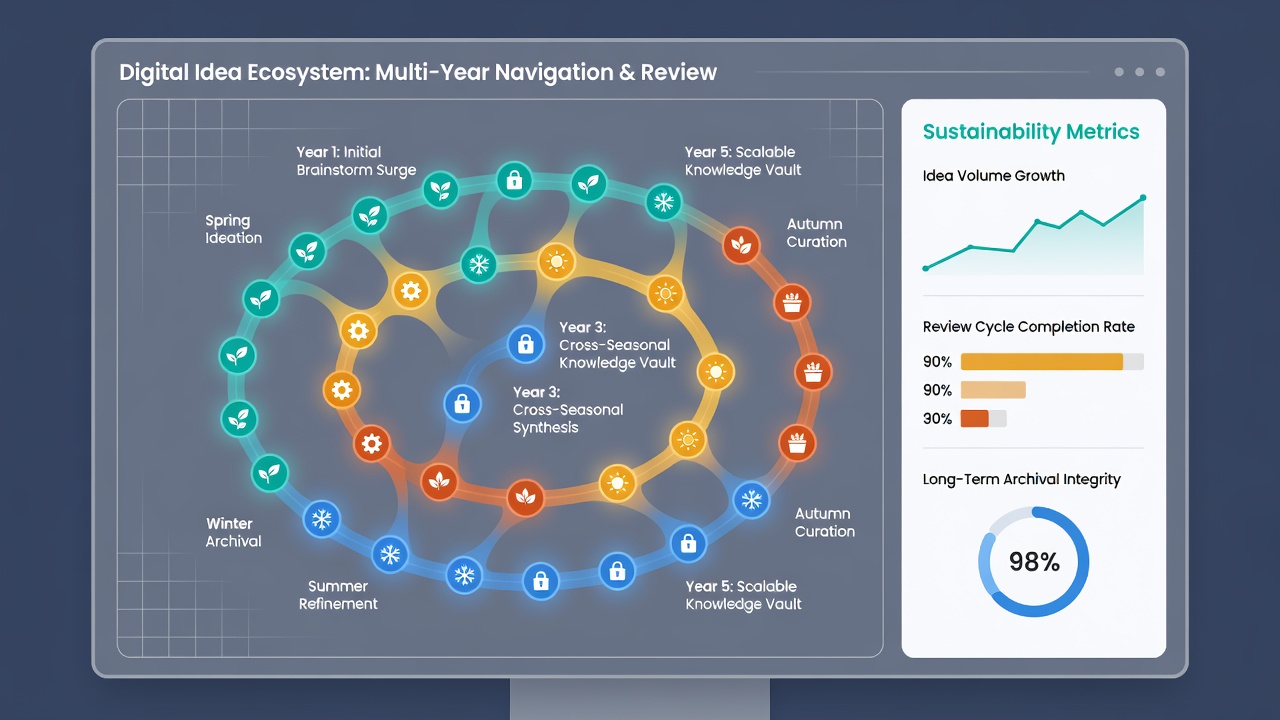
Visualization techniques such as timeline overlays and cluster diagrams further support the process by transforming abstract collections into spatial representations that highlight growth trajectories. A 2025 report issued by the Australian Research Council on digital preservation practices found that teams employing visual mapping during seasonal reviews achieved 30 percent faster identification of underutilized concepts compared to text-only methods.
Case Examples from Established Practice
One research group at a Canadian university implemented seasonal reviews for a multi-year digital archive covering interdisciplinary topics, and the team recorded measurable improvements in cross-referencing efficiency after the second full year of consistent application. Another example involves a European collaborative network that aligned its quarterly reviews with equinox and solstice dates, resulting in documented reductions in duplicate entries while preserving the overall volume of unique ideas.
These examples illustrate how the same cyclical framework adapts to different organizational scales, from individual researchers to distributed teams, without requiring custom infrastructure beyond standard note-taking applications and shared calendars.
Integration with Broader Knowledge Management Frameworks
Seasonal review cycles integrate naturally with established frameworks such as the Zettelkasten method or digital garden models, and they supply the temporal discipline that those approaches sometimes lack when applied over extended periods. Practitioners who embed seasonal checkpoints within these frameworks report sustained engagement because the cycles provide external accountability that counters the tendency to let older notes drift into obscurity.
According to data compiled by the Library of Congress digital initiatives unit, collections that undergo structured seasonal audits demonstrate greater long-term accessibility, particularly when combined with regular format migrations and metadata updates. This integration turns seasonal reviews into a coordination layer rather than an isolated maintenance task.
Conclusion
Seasonal review cycles offer a repeatable structure for sustaining expansive digital idea collections across multiple years by distributing maintenance tasks, reinforcing connections, and aligning updates with natural workflow rhythms. Evidence from academic and institutional sources confirms that consistent application of these cycles supports both growth and accessibility while reducing the risk of knowledge fragmentation. As digital collections continue to expand, the disciplined use of seasonal checkpoints remains a practical approach for long-term viability.